Customer identity solutions CIAM

TL;DR
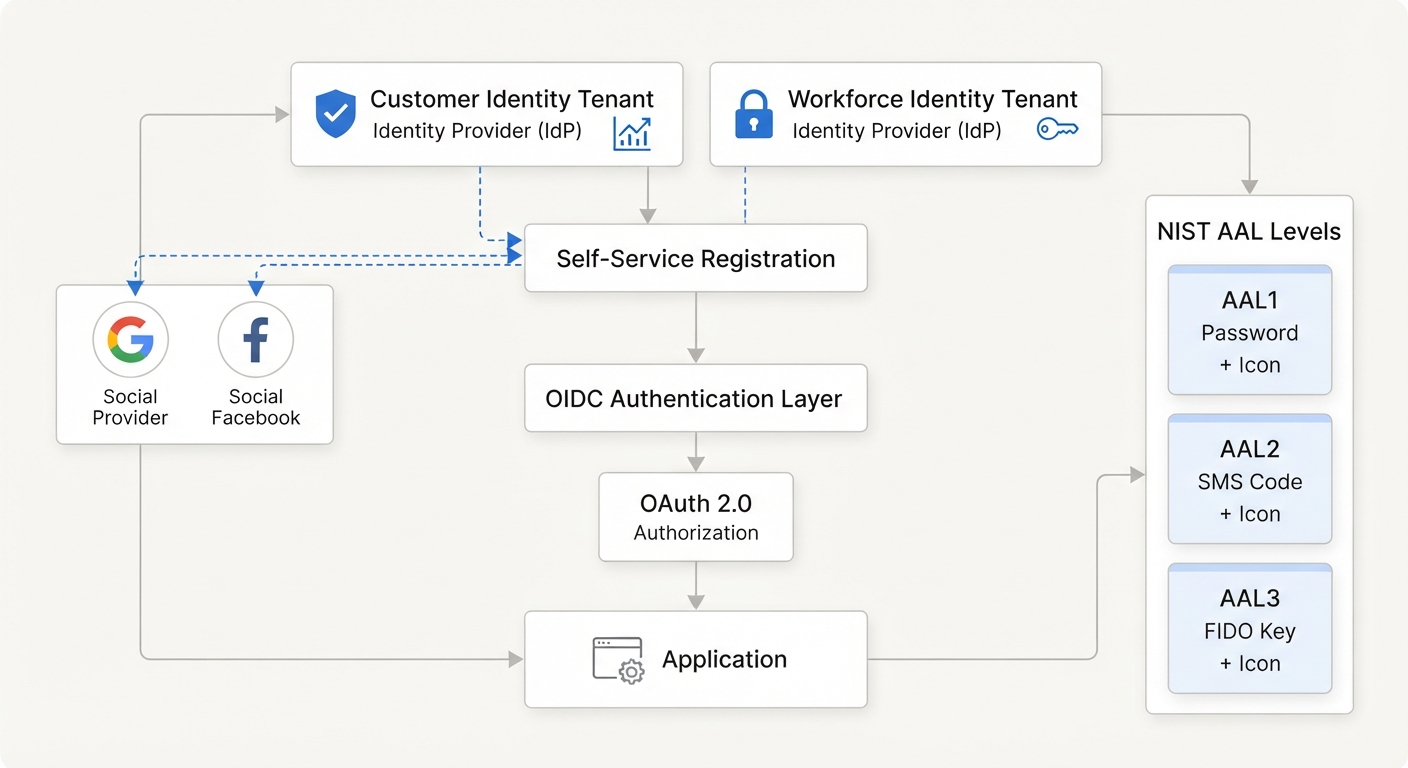
- CIAM systems manage external user lifecycles with self-service registration, OIDC authentication, and NIST AAL compliance, separating customer and workforce ide
TL;DR
- CIAM systems manage the lifecycle of external users, supporting massive scale, self-service registration, and diverse authentication methods.
- Customer identity and workforce identity must reside in separate tenants to maintain distinct risk models and compliance boundaries.
- Self-service registration allows users to create accounts without administrative intervention, often using social providers to confirm identity.
- OpenID Connect (OIDC) is the identity layer on top of OAuth 2.0, enabling applications to verify user identity via an external provider.
- NIST SP 800-63B defines three Authenticator Assurance Levels (AALs) that dictate the required strength and resistance of authentication methods.
Okta Is the Independent Customer Identity Solution
Okta provides the secure, independent control plane for managing customer identities at scale, balancing frictionless user access with rigorous security protocols. By decoupling customer identity from internal workforce systems, organizations can ensure that their digital identity architecture remains both scalable and compliant.
This independence allows businesses to pivot their customer engagement strategies without being tethered to the constraints of legacy corporate identity stores. It creates a dedicated environment where the primary objective is the seamless conversion and retention of the customer base.
Core Capabilities of Customer Identity and Access Management (CIAM)
CIAM systems are purpose-built to manage the lifecycle of external users, such as customers, partners, or citizens, rather than internal employees. Unlike workforce IAM, which focuses on controlled, internal-only access, CIAM must support massive scale, self-service registration, and a diverse range of authentication methods as defined in the OWASP Authentication Cheat Sheet.
In production, I see significant risk when organizations attempt to consolidate these two domains. Customer identity and workforce identity should never share the same tenant. Their risk models, compliance obligations, and user expectations are fundamentally different. A breach in a customer-facing portal should not provide a lateral path into internal corporate resources, which often stems from CWE-269.
Furthermore, it is a common misconception that single sign-on (SSO) alone satisfies SOC 2 requirements. While SSO provides essential access control, it does not address the broader requirements for logging, monitoring, or change management. A robust CIAM strategy requires a comprehensive approach to authentication and authorization that goes well beyond simple login convenience.
Organizations must understand that CIAM is not a static installation but a dynamic infrastructure component. It serves as the primary gateway for user interaction and data collection. By maintaining a separate tenant, IT teams can apply specific security policies tailored to the public-facing nature of customer applications, such as stricter rate limiting or specialized geolocation-based access rules, without interfering with the internal workforce's productivity requirements.
Self-Service Registration and Progressive Profiling
CIAM platforms prioritize user experience by allowing individuals to create accounts without administrative intervention. This self-service registration often leverages email verification or social providers to confirm identity per the OpenID Connect Core 1.0 specification.
To maintain data integrity, you must implement strict validation on all registration fields. This prevents malicious data injection and ensures that the information collected is accurate for downstream marketing or personalization systems. Without these checks, your database becomes a liability rather than an asset.
You must also protect your registration endpoints from automated abuse. Use rate limiting and CAPTCHA to prevent the creation of bot accounts, which are frequently used for credential stuffing or fraudulent activity as detailed in the OWASP Authentication Cheat Sheet. By stopping these automated attacks at the point of entry, you reduce the risk of account takeover before it begins.
Progressive profiling further enhances this flow by minimizing initial friction. Instead of forcing a user to fill out a lengthy form during the first interaction, you request only the essential data points needed for the immediate transaction. As the user engages more deeply with your platform, you can intelligently prompt for additional attributes. This balance between ease of use and data collection is vital for long-term customer retention.
Consent Management and Privacy Compliance
Managing user data rights under regulations like GDPR and CCPA requires a granular approach to consent. You must decouple consent records from the primary user profile. This allows consent to be revoked or updated independently without requiring a full account deletion or profile reset.
Storing consent as a simple boolean flag, such as 'consented=true', is a major risk. If you cannot prove exactly what a user consented to, when they did it, and which version of your privacy policy was active at that time, you face an inability to prove compliance during an audit. This failure leads directly to significant legal and financial penalties. A mature CIAM solution maintains a versioned audit trail for every consent event, ensuring you remain compliant as regulations evolve.
Compliance is not a one-time setup but a continuous lifecycle management process. As privacy laws update across different jurisdictions, your CIAM platform should offer the flexibility to prompt users for updated consent without interrupting their current session. By centralizing these consent records, you create a single point of truth that can be easily queried by legal or compliance teams. This visibility is essential for responding to Data Subject Access Requests (DSARs) in a timely and accurate manner.
Social Login and External Federation
CIAM systems simplify user access by integrating with external identity providers, allowing customers to use existing credentials. This federation strategy reduces friction and improves conversion rates in high-volume environments.
OpenID Connect for Modern Apps
OpenID Connect (OIDC) is the standard identity layer on top of OAuth 2.0. It enables relying parties to verify user identity via an external provider and receive claims in an ID Token. It is the preferred choice for modern web and mobile applications due to its lightweight nature.
SAML 2.0 for B2B Integration
SAML 2.0 remains a critical federation standard for B2B customer scenarios. Many enterprise partners require integration with their existing corporate identity providers. In my experience, OIDC is not a universal SAML replacement. Many enterprise applications still rely on SAML assertions and artifact binding, so coexistence is the realistic end state for most organizations.
Namespace User Identifiers
When supporting multiple identity providers, the application must namespace user identifiers, such as using an idp_id:user_id format. This prevents account spoofing or collision between providers as outlined in the ASVS 5.0.0 authentication requirements. Without namespacing, a user from one provider could potentially masquerade as a user from another, leading to unauthorized access, which is a common manifestation of CWE-290.
Federation Strategy
- Use OIDC for consumer-facing applications to leverage modern claims-based identity.
- Maintain SAML 2.0 support for B2B partners who require enterprise-grade federation.
- Always enforce strict namespacing to ensure identity uniqueness across disparate providers.
These strategies ensure that your application remains agnostic regarding the source of the identity. By abstracting the federation layer, you can add or remove providers as business needs change without refactoring your core application logic. This modularity is a hallmark of a mature CIAM implementation, allowing you to support diverse user bases ranging from individual retail consumers to large enterprise clients with their own internal identity infrastructures.
Scalable Authentication and MFA
Authentication in high-volume customer environments must balance security with user experience. You must define your security posture based on three Authenticator Assurance Levels (AALs) as defined by NIST. These levels dictate the required strength and resistance of authentication methods for your specific risk profile.
Adaptive Authentication
Adaptive authentication uses context, such as IP address, device fingerprint, or time of day, to trigger step-up multifactor authentication (MFA) only when the risk score exceeds a defined threshold as noted in the OWASP Authentication Cheat Sheet. This approach minimizes friction for legitimate users while maintaining a high security bar for suspicious sessions, helping to mitigate risks associated with CWE-287.
MFA Fatigue Prevention
You must implement number-matching for push-based MFA. This safeguard prevents 'MFA fatigue' attacks where users are prompted to approve fraudulent login attempts repeatedly. It forces the user to interact with the specific login request, making it significantly harder for attackers to bypass the check through social engineering.
Phishing Resistance
A common misconception is that MFA is inherently phishing-proof. Never imply this to your stakeholders. Even FIDO2, while phishing-resistant, is not a silver bullet. Push notifications or OTP factors can still be phished if the user is tricked into providing the code. Always prioritize phishing-resistant factors like hardware security keys where the risk profile demands it.
To implement these controls effectively, you must maintain a feedback loop between your security operations center and the CIAM configuration. If you detect an uptick in suspicious activity from specific regions or device types, you should be able to tighten adaptive authentication rules in real-time. This agility is what separates a modern CIAM implementation from a stagnant, legacy credential store. Security is not a set-and-forget configuration; it requires constant tuning and monitoring to stay ahead of evolving threat vectors.
Session Management and Profile Unification
Session management involves tracking the user's authenticated state via JSON Web Tokens (JWTs) and ensuring secure logout across all applications using single sign-out protocols. If you fail to rotate or revoke refresh tokens upon a password change, session hijacking persists after user remediation. This leads to unauthorized account access long after the user believes they have secured their account.
For all client-side and mobile applications, you must use the OIDC Authorization Code Flow with PKCE as defined in the NIST SP 800-63C implementation resources. This prevents token interception in the browser or device, ensuring that the authentication process remains secure even on potentially compromised client environments. By centralizing session state, you provide a consistent experience while maintaining the ability to terminate sessions globally when a threat is detected.
Profile unification serves as the final pillar, ensuring that data gathered across multiple touchpoints is merged into a single, comprehensive view of the customer. Whether the user interacts via a mobile app, a web portal, or an in-store kiosk, your CIAM system should recognize them and maintain a consistent session and profile. This unified identity is crucial for delivering personalized experiences while keeping security context intact across different platforms.
The Bottom Line on Customer Identity
CIAM is not merely a tool for login; it is the foundation for secure, scalable, and compliant customer engagement. By separating customer identity from workforce systems, implementing modern federation standards, and enforcing adaptive authentication, you reduce your attack surface while enabling growth. The goal is to build a resilient architecture that respects user privacy and secures the digital perimeter.
Investing in a dedicated CIAM strategy empowers your organization to scale without the friction typically associated with legacy identity management. As your customer base grows, your infrastructure will be capable of handling increased volume and complexity, ensuring that security measures evolve alongside your business requirements. This focus on long-term sustainability is essential for maintaining customer trust in an era of increasing digital threats.
Frequently Asked Questions
What is customer identity and access management (CIAM)?
CIAM is a specialized solution that manages the digital identities of external users. It focuses on massive scale, self-service registration, and providing a seamless experience while maintaining rigorous security for customer-facing applications.
How is CIAM different from traditional workforce IAM?
Workforce IAM manages internal employees with controlled access. CIAM manages external users, requiring support for social login, massive scale, and self-service registration, all while maintaining a distinct risk model from internal corporate systems.
Does SSO satisfy SOC 2 compliance?
No. SSO only covers access control. SOC 2 compliance requires comprehensive logging, monitoring, and change management processes that SSO alone cannot provide. You must implement additional controls to meet these audit requirements.
Is MFA phishing-proof?
No. While FIDO2 is phishing-resistant, other common factors like push notifications and OTPs can still be phished. You should prioritize phishing-resistant factors and never rely on MFA as a complete solution for phishing.